
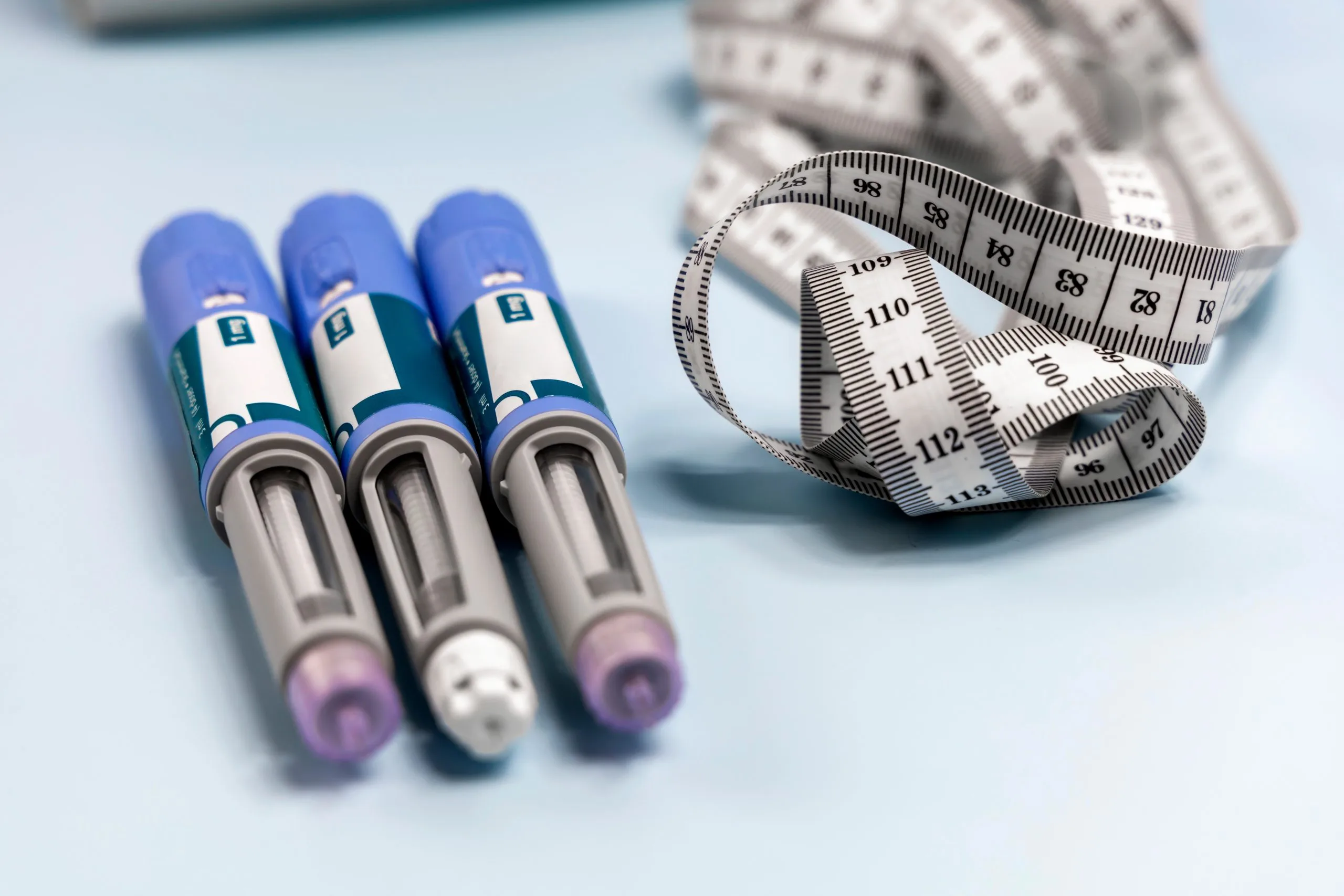
Ozempic is an FDA-approved, brand-name injectable approved to treat type 2 diabetes, while compounded semaglutide is a version of the same active ingredient mixed by a licensed compounding pharmacy for an individual patient. That means it is not FDA-approved as a finished product, may include added ingredients like B12, and can vary in dosing and quality from pharmacy to pharmacy. Both can be used off-label for weight loss under medical supervision, but the differences in oversight and formulation should shape the conversation you have with your provider before you start.
Our wellness center in Bartonville pairs weight-loss injections with one-on-one coaching, offering brand-name and compounded options depending on what fits each client.
Semaglutide is a medication in a class called GLP-1 receptor agonists. GLP-1 stands for glucagon-like peptide-1, a hormone your gut naturally releases after you eat – it tells your pancreas to release insulin when blood sugar rises, slows how quickly food leaves your stomach, and signals your brain that you are full.
Semaglutide is a lab-made version of that hormone, engineered to last much longer in the body. Natural GLP-1 breaks down within minutes; semaglutide sticks around for days, which is why most versions are injected just once a week.
What that looks like in practice:
Food stays in the stomach longer, so you feel full sooner and stay full longer
The constant mental chatter about food – what some patients call “food noise” – often quiets down
Portion sizes shrink naturally rather than through willpower alone
Blood sugar becomes steadier, reducing the crash-and-crave cycle that drives snacking
Semaglutide is not a stimulant and not an appetite suppressant in the old-fashioned sense. It works with your body’s existing hunger and fullness signaling rather than overriding it.
Compounding is the practice of a licensed pharmacist preparing a medication tailored to an individual patient. It is a long-standing, legitimate part of pharmacy – think of a pediatric antibiotic turned into a liquid for a child who cannot swallow pills, an allergen-free or preservative-free formulation, or a dosage not commercially available.
Compounded semaglutide is prepared by a compounding pharmacy rather than manufactured and packaged by a pharmaceutical company. The pharmacy sources the active pharmaceutical ingredient (API), prepares the sterile solution, and dispenses it in a vial or pre-filled syringe against a prescription for a specific patient.
Here is the key difference: the FDA does not review or approve compounded drugs. Approved products go through review of manufacturing data, clinical trials, purity testing, and labeling. Compounded medications skip that process by design, because they are made in small batches for individual patients.
That does not automatically make compounded medication unsafe. State boards of pharmacy oversee traditional 503A compounding pharmacies, and larger 503B outsourcing facilities register with and are inspected by the FDA. But the oversight is different in kind – with a brand-name product, every vial comes from a standardized process; with a compounded product, quality depends heavily on the specific pharmacy.
Compounded semaglutide became widespread for a few overlapping reasons:
Supply shortages. When demand for GLP-1 medications surged, the FDA listed semaglutide on its drug shortage list. Under federal law, that gives compounding pharmacies more latitude to prepare copies. Shortage status changes over time, and when the FDA declares a shortage resolved, that latitude narrows considerably.
Access and availability. Even outside formal shortages, brand-name GLP-1s have not always been easy to obtain consistently at every pharmacy, particularly at specific dose strengths.
Clinical customization. Some patients tolerate semaglutide poorly at standard step-up doses. A compounded prescription lets a provider move between dose levels in smaller increments – easing someone through the transition where nausea most often appears.
Combination formulations. Some preparations pair semaglutide with vitamin B12, sometimes with the goal of reducing nausea, though evidence on that specific benefit is limited.
Ozempic is the brand name for a once-weekly injectable semaglutide product manufactured by Novo Nordisk for managing type 2 diabetes. The significant weight reduction observed in Ozempic patients led to widespread off-label use – and ultimately prompted the development and approval of Wegovy, a higher-dose semaglutide product approved specifically for weight management.
Ozempic contains semaglutide as its active ingredient, along with disodium phosphate dihydrate, propylene glycol, phenol, and water for injection – inactive ingredients that stabilize the molecule and ensure proper function.
It comes in a proprietary pre-filled, multi-dose pen with a dose selector. The standard titration schedule:
0.25 mg once weekly for four weeks – not intended to be therapeutic; it exists purely to let your body adjust and reduce gastrointestinal side effects
0.5 mg once weekly for at least four weeks
1 mg once weekly if further blood sugar control is needed
2 mg once weekly as the maximum approved dose
Each step-up happens only after at least four weeks at the previous dose, and only if the prescriber determines it is appropriate. The pen delivers a fixed set of dose options – you cannot dial an in-between amount.
The injection goes into the abdomen, thigh, or upper arm, on the same day each week. If a dose is missed, specific rules govern when it can be taken late and when it should be skipped.
This is the single largest difference.
Ozempic went through the FDA’s full approval pathway for managing type 2 diabetes: preclinical work, phase 1 through phase 3 trials involving thousands of participants, manufacturing inspections, and ongoing post-market safety surveillance. Every batch is made under validated manufacturing standards, and the prescribing information – dosing, warnings, contraindications, side effect frequencies – is FDA-reviewed.
Compounded semaglutide has not gone through any of that as a finished product. The FDA does not review compounded formulations for safety, effectiveness, or quality before they reach patients.
That does not mean compounded medication is inherently dangerous – it means responsibility for quality shifts to the compounding pharmacy and the prescriber who selects it. A reputable outsourcing facility that registers with the FDA, follows sterile compounding standards, and performs third-party potency and sterility testing operates very differently from an unvetted online seller.
If a compounded preparation contains genuine semaglutide base at an accurate concentration, there is no pharmacological reason it would work differently from a brand-name product at an equivalent dose. The GLP-1 mechanism is identical.
The caveats are all about the “if”:
Potency accuracy. Does the vial actually contain the labeled amount of active ingredient?
Correct active ingredient. Is it semaglutide base, not a salt form or a related peptide?
Stability. Does the product remain potent through the vial’s stated use period when stored properly?
Dosing accuracy. Compounded vials require you to draw up your own dose, introducing measurement error that a pre-set pen does not have.
Impurities. Raw ingredients may not be pure, or unknown substances could be introduced during compounding.
What is clear from both research and clinical experience: the medication works far better paired with real behavioral support – protein-forward eating, resistance training to protect lean mass, hydration, sleep, and regular check-ins. That is why our weight-loss programs pair GLP-1 support with one-on-one coaching rather than simply handing over a prescription.
For Ozempic, safety monitoring is continuous and centralized. Adverse events are reported through established channels, manufacturing facilities are inspected, and any batch issue triggers a formal recall process. You receive a consistent, sterile, stable product in a patented delivery device.
For compounded semaglutide, the picture varies by source. Well-run pharmacies follow United States Pharmacopeia standards, maintain clean-room environments, and test finished products. Poorly run operations, particularly those selling directly to consumers online without a legitimate prescriber relationship, may do none of that. The most common effects are gastrointestinal:
Nausea, especially in the first weeks and after each dose increase
Vomiting
Diarrhea or constipation
Abdominal pain
Reduced appetite (partly the point, but it can be excessive)
Burping, heartburn, and gas
Fatigue and headache
Most are mild to moderate, dose-related, and improve with time. Slower titration under medical supervision, smaller meals, avoiding high-fat and greasy foods, staying hydrated, and eating protein first all help.
Less common but more serious concerns associated with GLP-1 medications include pancreatitis, gallbladder problems, gastroparesis (severe delayed stomach emptying), kidney issues stemming from dehydration, worsening diabetic retinopathy, and low blood sugar when combined with insulin or sulfonylureas. Semaglutide carries a boxed warning about thyroid C-cell tumors observed in rodent studies and should not be used by anyone with a personal or family history of medullary thyroid carcinoma or multiple endocrine neoplasia syndrome type 2.
If you and your provider decide compounded semaglutide is the right fit, transparency is key. These are the things worth verifying.
A real medical evaluation comes first. Any legitimate GLP-1 program starts with a clinical assessment – health history, current medications, contraindications, labs where appropriate, and clear goals. At Inner Radiance Wellness and Aesthetics, your weight management program begins with a $99 consultation, followed by a dedicated telehealth good-faith exam with a nurse practitioner before any medication is prescribed. If a service offers to ship you a GLP-1 after a two-minute web form, that is a warning sign.
Ask where the medication is compounded. You are entitled to know the pharmacy name. Ask whether it is a state-licensed 503A compounding pharmacy or an FDA-registered 503B outsourcing facility, whether it complies with USP <797> sterile compounding standards, and whether it performs third-party testing for potency and sterility.
Confirm the active ingredient is semaglutide base. Not semaglutide sodium. Not semaglutide acetate. Not a “semaglutide-like peptide.” Ask directly.
Get dosing instructions in writing. Instructions should specify the exact volume to draw, in the same units marked on your syringe, for every stage of titration.
Ask about follow-up. Weekly or biweekly check-ins early on, then regular follow-ups, should be built into the program. Our Weight Loss Follow-Up visits are offered by telehealth, which keeps monitoring convenient without skipping it.
Ask about storage and beyond-use dating. Compounded products generally require refrigeration and have a defined use window. Know both.
Understand the plan beyond the medication. Ask what happens with nutrition, muscle preservation, and the transition off medication. A GLP-1 that produces rapid loss with no behavioral foundation tends to produce rapid regain.
Look at the whole-body approach. Many of our clients pair their program with body contouring options like CoolSculpting or RF+HIFEM for stubborn areas, or use the infrared sauna and wellness capsule as part of a broader routine. Having those services in one Bartonville location makes it easier to stay consistent.
Many people who started on compounded semaglutide eventually consider moving to a brand-name product – often because of changes in compounded availability, shifting insurance coverage, or a preference for an FDA-approved formulation. The switch is generally straightforward, but it should never be improvised.
Doses do not always translate directly. Compounded doses may be expressed in units or milliliters, while brand-name pens are dialed in milligrams. Your prescriber needs to calculate your actual milligram dose and match it to the closest available pen dose.
You may need to step back down. If your compounded dose sits between two fixed pen doses, your provider will usually place you at the lower one and titrate up rather than jumping higher.
Restarting rules apply after gaps. If more than a couple of weeks pass between your last compounded dose and your first brand-name dose, you may need to restart at a lower dose and re-titrate.
Injection technique changes. Moving from a vial and syringe to a pre-filled pen means new instructions – attaching needles, priming, dialing the dose, holding for the full count.
Expect a brief adjustment period. Some people notice mild differences in appetite suppression or side effects in the first week or two, even at an equivalent dose. This usually settles.
Keep your follow-up schedule. Weight, appetite, side effects, and blood sugar (where relevant) should all be reviewed after the change.
The reverse direction – brand-name to compounded – follows the same principles: accurate dose conversion, written instructions, and close follow-up. And this is not a one-time choice. Availability, tolerance, cost, and your response to treatment can all shift over months of therapy, so it is reasonable to revisit the decision with your provider.
The most important decision is not just which medication to use – it is who you trust to guide you.
If you are in the Bartonville area and weighing your options, our weight management program at Inner Radiance Wellness and Aesthetics combines GLP-1 support with one-on-one coaching and telehealth follow-ups, all in one boutique setting. Learn more about us and how we can support your journey.
Call (940) 295-5512 to schedule your $99 consultation

About the Author
Inner Radiance Wellness & Aesthetics
Inner Radiance Wellness & Aesthetics blends advanced aesthetic treatments with whole-body wellness to help you look and feel your best. Experience personalized, results-driven care in a calm, welcoming space.
August 11, 2026